1. Industry Background & Market Demand
Global low-voltage terminal
power distribution systems are undergoing continuous standardization and refinement, driven by the upgrading of commercial buildings, civil residential facilities and industrial miniature power distribution units. In European and American markets, IEC low-voltage electrical standards and local building electrical codes impose strict requirements on circuit safety protection, operational stability and equipment compatibility of terminal distribution components. With the proliferation of precision electrical equipment and diversified load types in terminal circuits, traditional simple switching components can no longer meet the dual demand of circuit fault protection and frequent operational stability.
There is a sustained market demand for compact, high-breaking-capacity and high-reliability miniature protection switches. End users including property developers, electrical engineering contractors and industrial equipment manufacturers prioritize products with stable overload and short-circuit protection performance, standardized rail mounting structure and high flame-retardant safety. As a core terminal protection component, the YCB series miniature circuit breaker fills the demand gap of cost-effective and high-standard low-voltage circuit protection in civilian and general industrial distribution scenarios, and is widely adapted to the mainstream technical specifications of European and American low-voltage power distribution systems.
2. Core Concept & Key Technical Principles
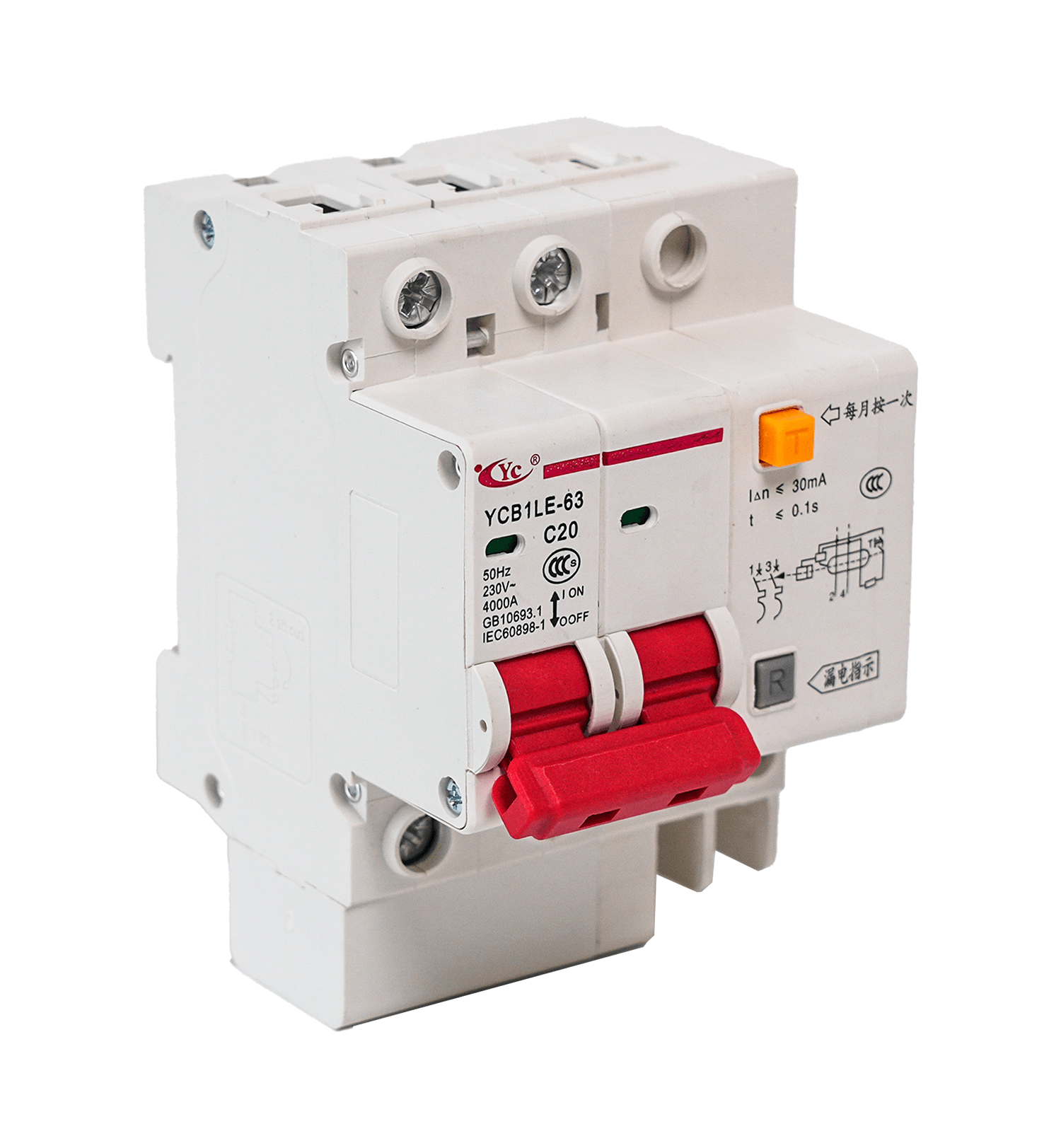
A miniature circuit breaker is a modular low-voltage protection device dedicated to terminal power distribution circuits, focusing on passive fault protection and manual circuit switching functions. The core technical logic of the YCB series miniature circuit breaker is based on electromagnetic and thermal double protection mechanisms, which is the core technical support for its stable circuit protection capability.
The thermal protection mechanism relies on the bimetallic strip thermal deformation principle. When the circuit suffers long-term overload and the current exceeds the rated value, the bimetallic strip generates continuous heat accumulation and bends to drive the tripping mechanism, cutting off the circuit to avoid wire aging and fire risks caused by overload heating. The electromagnetic protection mechanism targets short-circuit faults: instantaneous overcurrent generated by circuit short-circuit induces strong electromagnetic force in the internal electromagnetic coil, which instantly triggers the tripping structure to complete rapid circuit breaking. In addition to automatic fault protection, the product supports non-frequent manual closing and opening operations, realizing flexible switching control of normal circuit power supply without damaging the circuit stability. This dual-protection technical architecture enables the YCB series miniature circuit breaker to adapt to complex terminal circuit load changes.
3. Product Structure, Performance, Materials & Manufacturing Process
3.1 Product Structural Design
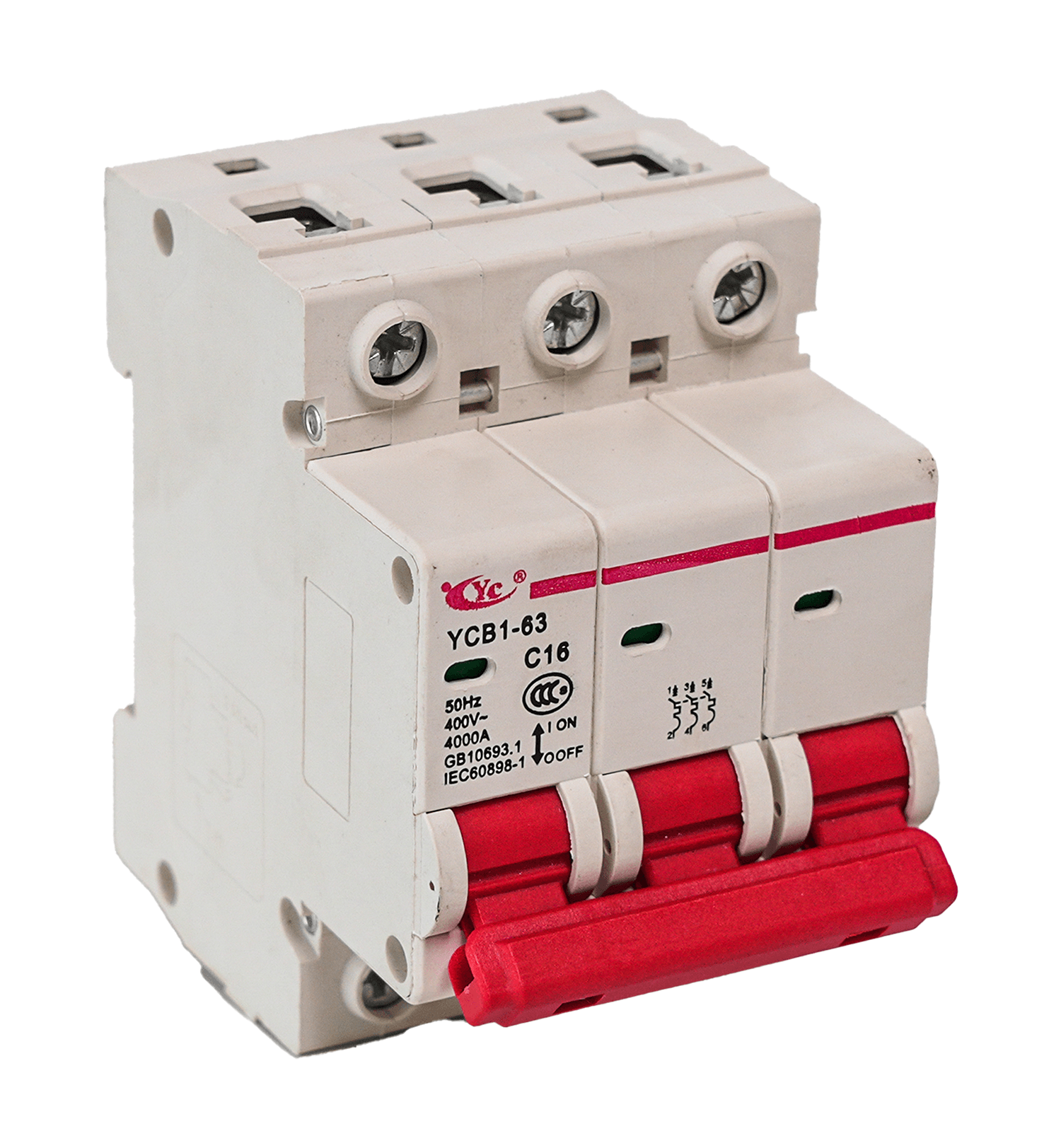
The YCB series miniature circuit breaker adopts an integrated plastic shell modular structure with a standardized rail mounting design, which is compatible with mainstream electrical installation rails in European and American markets. The internal structure is divided into three core functional units: thermal overload protection unit, electromagnetic short-circuit protection unit and manual operating transmission unit. The overall structure is compact and reasonably arranged, which effectively reduces internal component interference, simplifies on-site installation and replacement procedures, and realizes miniaturization and lightweight of terminal protection equipment.
3.2 Core Performance Parameters
The product is applicable to AC 50Hz/60Hz low-voltage circuits, with a rated working voltage of 220V/380V and a maximum rated current of 63A, covering the current demand of most terminal lighting, power distribution and small equipment circuits. It features high breaking capacity, which can quickly and reliably cut off short-circuit current in case of circuit faults, avoiding secondary damage to lines and electrical equipment caused by arc continuation. The product maintains stable protection accuracy under long-term working conditions, with low tripping failure rate and no misoperation in normal load operation, ensuring the continuity and safety of power supply.
3.3 Material Selection Standards
The outer shell and internal insulating structural parts are made of high-impact modified flame-retardant engineering plastics. This material has excellent anti-aging, anti-collision and flame-retardant properties, which can resist external mechanical impact and high-temperature arc erosion generated during circuit breaking, and will not burn or spread flame in case of local high temperature. The internal conductive components adopt high-purity copper materials with low resistivity and good electrical conductivity, which reduces circuit power consumption and heat generation during operation, and improves the overall operational stability of the miniature circuit breaker.
3.4 Core Manufacturing Process
The product adopts precision die-casting and automated assembly processes. The conductive parts are formed by one-time precision die-casting to ensure consistent dimensional accuracy and electrical conductivity of components. The internal tripping mechanism is assembled by automated equipment with millimeter-level assembly tolerance control, which ensures the sensitivity and consistency of overload and short-circuit tripping. All finished products undergo full-load aging testing and short-circuit breaking performance sampling inspection before leaving the factory to eliminate defective products and ensure batch product stability.
4. Key Factors Affecting Product Quality & Performance
The operational reliability of the YCB series miniature circuit breaker is affected by multiple links including material quality, component precision and process control. First, the performance of flame-retardant and impact-resistant shell materials directly determines the product's safety and service life in high-temperature and complex installation environments. Inferior materials are prone to aging and deformation after long-term operation, which may lead to shell cracking and insulation failure.
Second, the precision of the internal tripping mechanism is the core factor affecting protection accuracy. The thickness uniformity and thermal deformation stability of the bimetallic strip determine the overload tripping threshold; the coil turns and electromagnetic structural accuracy of the electromagnetic unit affect the response speed of short-circuit protection. In addition, the assembly gap of internal transmission components will directly lead to tripping delay or failure if it deviates from the standard range. Finally, factory aging test standards and batch quality control levels determine the long-term operational stability of the product in terminal circuits.
5. Supply Chain & Supplier Selection Criteria
The core components of the YCB series miniature circuit breaker include flame-retardant plastic particles, precision copper conductive parts, bimetallic strips and electromagnetic coils. The supplier selection of core raw materials follows strict industrial standards, fully adapting to the quality requirements of European and American low-voltage electrical markets.
For flame-retardant plastic materials, suppliers must provide IEC flame-retardant grade certification and long-term aging resistance test reports to ensure that the materials meet the safety standards of building electrical equipment. For metal conductive and tripping components, suppliers are required to have precision metal processing capabilities and stable batch production quality, with strict control over material resistivity, structural dimensional tolerance and mechanical fatigue resistance. In terms of finished product processing and assembly, cooperative manufacturers need to have automated production lines and complete quality inspection systems, and pass international electrical product quality system certification, to ensure that the batch consistency and performance stability of the miniature circuit breaker meet B2B end-user procurement standards.
6. Industry Pain Points & Common Technical Problems
6.1 Traditional Industry Pain Points
In the low-voltage terminal distribution industry, many ordinary miniature protection switches have prominent problems such as low breaking capacity, poor material flame-retardant performance and unstable tripping accuracy. Some products are prone to mis-tripping under normal load fluctuation, affecting the normal power supply of electrical equipment; inferior shell materials are easy to age and burn in high-temperature working environments, bringing potential safety hazards to building circuits. In addition, many products have non-standard structural sizes, poor compatibility with international standard rails, and inconvenient on-site installation and replacement, increasing the construction and maintenance costs of electrical engineering.
6.2 Common Product Operation Problems
In actual application scenarios, miniature
circuit breakers often face two typical problems: long-term light overload non-tripping and instantaneous short-circuit tripping delay. The former is caused by insufficient sensitivity of the bimetallic strip structure, which leads to slow heat accumulation and failure to cut off the overload circuit in time; the latter is related to the insufficient structural stability of the electromagnetic tripping unit. In addition, products with poor process quality are prone to loose internal components after long-term vibration, resulting in abnormal switching operation.
7. Application Scenarios & Industrial Cases
Relying on stable protection performance and standardized structural design, the YCB series miniature circuit breaker is widely used in low-voltage terminal power distribution scenarios of various buildings and general industrial equipment, adapting to 50Hz/60Hz dual-frequency power supply environments.
In civil construction scenarios, the product is applied to residential building lighting circuits and household terminal power distribution systems, providing overload and short-circuit protection for household electrical lines, and realizing safe switching of daily power supply circuits. In commercial and office scenarios, it is used for power distribution protection of high-rise office buildings, shopping malls and commercial centers, matching the dense terminal circuit layout and frequent load switching characteristics of commercial buildings. In general industrial scenarios, the product is applied to small industrial equipment power supply circuits and factory lighting distribution systems, protecting low-power industrial equipment from circuit fault damage. In all scenarios, the product can complete non-frequent manual switching operations on the basis of reliable fault protection, meeting the dual operational needs of safety protection and circuit control.
8. Current Industry Trends & Future Development Direction
The global low-voltage miniature circuit breaker industry is currently developing towards miniaturization, high safety, high precision and strong compatibility. With the continuous improvement of international electrical safety standards, terminal protection components have higher and higher requirements for flame retardancy, impact resistance and breaking capacity. Meanwhile, with the popularization of smart power distribution systems, the industry is gradually transitioning from traditional passive protection to intelligent monitoring and protection integration.
In the future, the YCB series miniature circuit breaker will further optimize the internal structural precision and material performance, improve the accuracy of overload and short-circuit protection, and reduce the rate of misoperation and failure. On the basis of maintaining the advantages of compact structure and high cost performance, the product will expand the adaptation range of current and voltage parameters, and enhance the compatibility with intelligent power distribution modules. In addition, combined with the energy-saving and environmental protection trends of the electrical industry, the product will adopt more environmentally friendly high-performance flame-retardant materials to reduce energy consumption during operation, and meet the increasingly stringent environmental protection and safety standards of European and American markets.
9. FAQ
Q1: What frequency and voltage environments is the YCB series miniature circuit breaker suitable for?A: This series of products supports AC 50Hz and 60Hz dual power frequency operation, with a rated voltage of 220V/380V, which is compatible with the mainstream low-voltage power supply standards in Europe, America and most regions of the world, and covers conventional terminal power distribution scenarios.
Q2: Can the product be used for frequent circuit switching operations?A: The product is positioned as a terminal protection component, supporting non-frequent manual closing and opening of circuits. It is not suitable for high-frequency switching scenarios, so as to avoid mechanical wear of internal transmission components affecting protection accuracy and service life.
Q3: What is the core advantage compared with ordinary miniature circuit breakers?A: It adopts high flame-retardant and impact-resistant shell materials, with more reliable safety performance. The optimized internal double protection mechanism improves the breaking capacity and protection accuracy, and the standardized rail mounting structure has stronger installation compatibility, which is more adapted to commercial and building industrial application scenarios.
Q4: What are the main causes of tripping failure in actual use?A: The main reasons include long-term overload operation leading to aging of the bimetallic strip, loose internal assembly components caused by violent vibration of the equipment, and long-term use leading to dust accumulation and poor contact of the tripping mechanism. Regular inspection and maintenance can effectively avoid such faults.


 English
 Pусский
 العربية
 қазақ
қазақ



 Whatsapp
 电话
电话